From 1287 to 1642

Some key dates:

At each change of Lord

DateMoulin nameThe placeLord's name
1287Moulin des BouëxièresLa Roche-SuhartHenri III of Avaugour gave in dowry, in 1287, the fief of La Roche-Suhart to his daughter Jeanne, during her marriage to Geoffroy de Dinan.
1317Moulin des BouëxièresBoisboisselChesnin the prevost
1420Moulin des Bouëxières dit du Marshal de BretagneLa Roche-SuhartOlivier de Blois then once released from Chantoceaux, in 1420, Duke Jean V very liberally rewarded all those who had supported him: Jean de Tournemine
1420Moulin des Bouëxières dit du Marshal de BretagneLa HunedayeJean de Tournemine, he was killed in 1427, in the combat of the Bas-Courils, delivered to the English, near the strikes of Mont-Saint-Michel
1439Moulin des Bouëxières dit du Marshal de BretagneLa Ville-SolonIn 1439, the house and the mansion of Ville-solon, belonged to the sieur and lady of La Roche-Jagu the Péan family then in 1494 Françoise de Péan remarried with Guillaume d'Acigné
1584Moulin des Bouëxières dit du Marshal de BretagneBuhen and Ville-solonGuillaume de Rosmadec
1608Moulin des Bouëxières dit du MaréchalBuhen and Ville-solonRadegonde of Rosmadec inherits his brother and marries Thébault de Boisgelin in 1582 she died in 1642
1644Moulin des Bouëxières dit du MarshalBuhen and Ville-solonJean de Boisgelin, squire of Buhen, lord of La Ville-Sollon, of the Ville-Robert
1672Moulin des Bouëxières dit du MarshalBuhen and Ville-solonGabriel de Boisgelin, knight, Marquis de Cucé, viscount of Mesneuf, lord of Loges, de Buhen, de Lantic
1789Moulin MaréchalBrittanyThe mill was confiscated after the 21st of Nivose, Year II
1799Maréchal MillCotes du NordSale of the mill by the Republic on the 18th of Prairial, Year 7
suhart

1287 Jeanne d'Avaugour

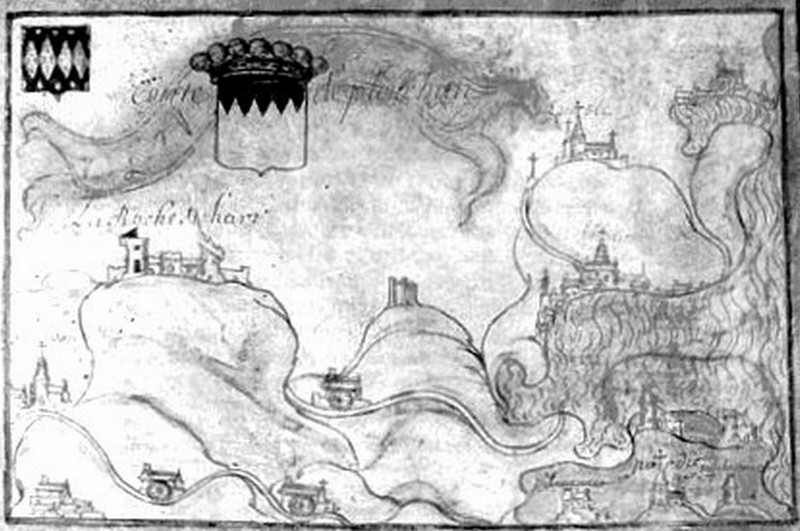
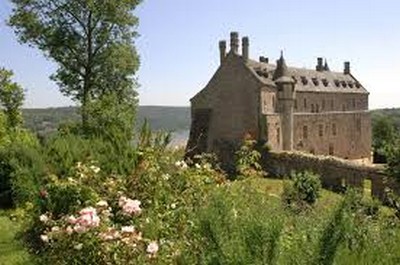
In this image, we can see the Roche-Suhart castle, the Cesson tower, the church of Trémuson, and the mills along the Gouët, probably the Bouexières mill, also known as the Maréchal mill.

Henry I was the first of the Avaugour line, having died in 1281. It was during his reign that Goëlo formed a historical entity that included:

the cantons of Paimpol, Lanvollon, Plouha, Pontrieux, Plouagat, Chatelaudren, Étables-sur-Mer, and the communes of Binic, Pordic, Plérin, and Trémuson;

Henry III d'Avaugour, the last Count of Goëlo of the eldest branch of the Avaugour family, had a sole heir: Jeanne d'Avaugour.

Jeanne d'Avaugour was married in June 1287 to Geoffroy de Dinan-Montafilant, son of Rolland de Dinan, Lord of Montafilant, and Anne de Léon. Rolland was one of Henry's most important vassals.

Jeanne d'Avaugour received a dowry of 720 livres, plus an annuity of 1,000 livres on the fief of La Roche-Suhart, in the parish of Trémuson. She died on March 5, 1299, and was buried in the family necropolis in Beauport.

Recumbent statue

1317 Chesnin Le Prevost

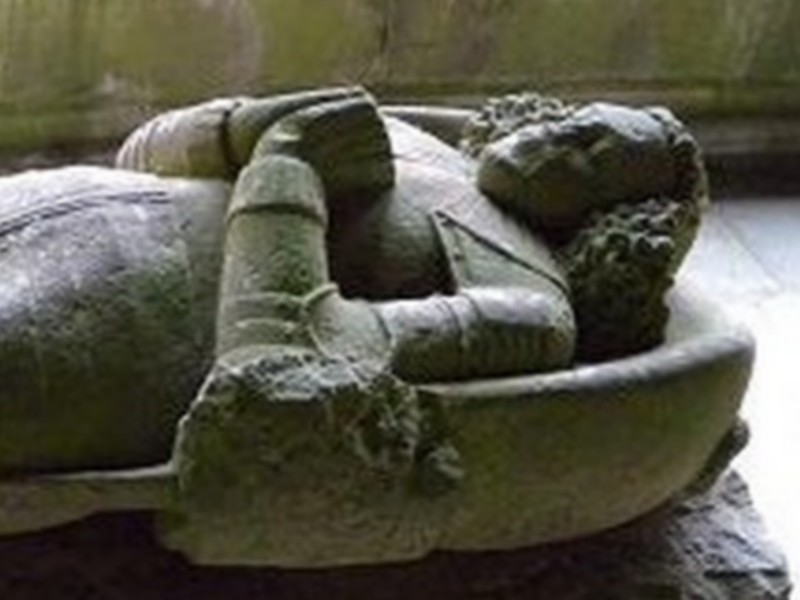
In this image: the recumbent statue of a knight of Boisboissel, in the cloister of Tréguier Cathedral. If the mill existed in 1317, it probably belonged to the Boisboissel family.

1317 is the official date of the beginning of the uninterrupted lineage of the Boisboissel genealogy.

It was also this division made on May 14, 1317, that served as proof and confirmed the nobility of knightly descent of the Boisboissels during the reformation of the nobility in 1669 by decree of August 7, 1669.

Chesnin Le Prevost, alive in 1308, knight, Lord of Boisboissel, settled by deed on Wednesday, the eve of Ascension Day, May 14, 1317, with the consent of his mother, Lady Gervaise, the share that belonged to his brothers, Alain and Juhel de Boisboissel.

In the paternal succession, Chesnin Le Prevost took possession of everything he owned in Goëlo, in the parishes of Tregomeur, Plérin, and elsewhere, including land, meadows, mills, rocks, and other properties.

Chesnin Le Prevost consented, by the same deed, to his mother, Dame Gervaise, assigning them 20 sous of income from her fiefs.

Clisson

1420 Olivier de Blois

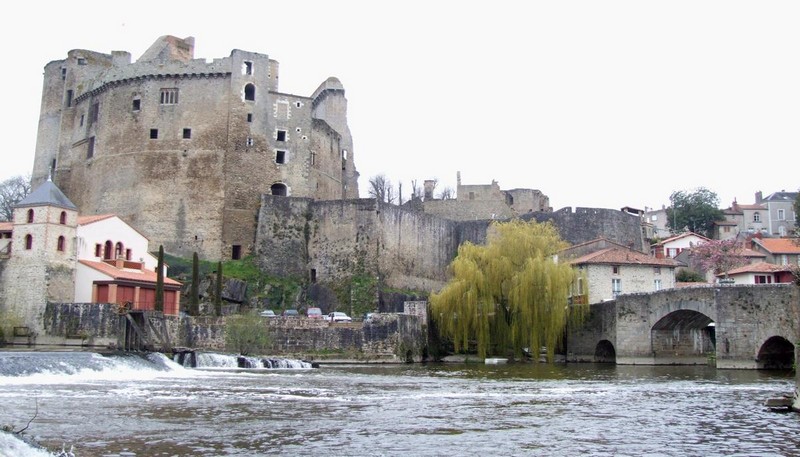
Image depicting the Château de Clisson

Marguerite de Clisson, Countess of Penthièvre, had been unable to forgive the insults inflicted on her father by Duke John IV. On February 12, 1420, she lured the Duke of Brittany, John V, into an ambush near his château at Chantoceaux.

She hoped to humiliate her prisoner to satisfy her grudges and, under threat of death, force him to abdicate his throne in favor of his eldest son: Olivier de Blois, heir to the rights of his grandfather Charles de Blois.

The news of Champtoceaux's shameful attack provoked an explosion of anger throughout Brittany. An army was organized and, one after the other, the Penthièvre strongholds were captured and sometimes dismantled.

Olivier de Blois, Marshal of Brittany, had treacherously seized the Roche-Suhart fortified castle and the surrounding property in the territory of Trémuson, part of Goëlo.

Champtoceaux fell to the Breton army in early July 1420. John V regained his freedom. He confiscated all the property of his accomplices.

The Roche-Suhart fortified castle was captured by the troops of Duke John V of Brittany, who confiscated all the property (including Goëlo) of the Countess of Penthièvre and her children.

A large part of Goëlo was then given to the Duke's brother, Count Arthur, the future Arthur III, while some lordships were given to other relatives of the sovereign who had participated in his liberation.

One of the sovereign's relatives was the lord of Hunaudaye: Jean II de Tournemine

hunaudaye

1420 John II of Tournemine

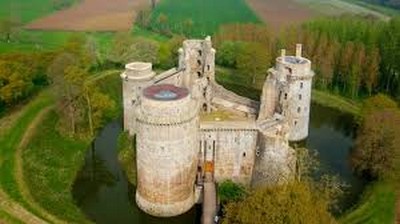
Image representing the Château de la Hunaudaye. John II de Tourmine had participated in the Liberation of the Duke. In 1420 Duke Jean V gave him the parishes of Plérin, Etables, Trégueur and Plélo.

Letter from Duke Jean V: Given the confiscation of all the property of Olivier de Blois and the good services of Robert de Dinan gives the lands and lordships of Plancouet, Flicelia, Saint Enogat, La Motte és Monfordis and Montbran,

With the exception of the annuities of our Bien Aimé Cousin Jehan of Tournemine Lord of the Hunaudaye takes on the titles all the rights, reasons and actions that we have at the parishes of Plérin, Estable, Trégueur and Plelo.

And with this, which he has in Nostred Forest and Garenne de Gouellou (Goello) their use for heating, edification and repair of his manor of La Roche Suart and his mills of the said place.

Jean II de Tournemine was killed on April 17, 1427 in Courtils near the strikes of Mont-Saint-Michel during an unreasonable and ineffective attack against the English.

In 1429 Jeanne d'Arc released Orléans then Selle-sur-Cher, Jargeau, Meung-sur-Loir, Beaugency, Patay.

lag

1439 Rolland Péan

Rolland Péan took part, in 1431, in the siege of Pouancé, and sworn in loyalty to the Duke, in 1437, with the knights and the squires of the diocese of Tréguier.

Françoise de Péan the elder, stirs up many lusts, a lord of the surroundings, Louis de Coëtmen takes him away in obscure circumstances. He made him his wife in 1490, but died two years later.

Guillaume d'Acigné, brother of Jean VI, married on March 13, 1494, Françoise Péan (1472-1555), heiress of the castle of La Roche-Jagu (Côtes d'Armor) whose father died in the Breton ranks at the Battle of St Aubin-du-Cormier in 1488.

From this marriage, many children were born. Among these children, Louis d'Acigné in turn became bishop of Nantes in 1532 and was buried with great fanfare in 1542 in the church of the Bonnel Nouvelles church in Rennes.

The couple seems to have abandoned La Roche-Jagu in favor of their lands in the vicinity of Rennes and their manor of the Ville-Mario.

Guillaume

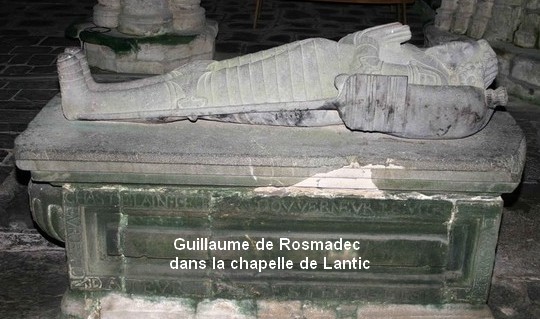
1584 Guillaume de Rosmadec

In 1584 during the acquisition by Guillaume de Rosmadec, it was indicated in the act of sale that the seigneury had "the privilege of justice".

There were two noble houses in the city city, to distinguish them: one was called "City Solon Rosmadec" and the other "City Solon Collet"

1589, Le Moulin Maréchal still belongs to the seigneury of the city city (the miller is called Pierre Armault).

Guillaume de Rosmadec Employa, the considerable fortune which had happened to him to become a large owner;

In 1584 he bought the land of Lantic from Marthe de la Porte, widow of Jean Le Porc, Baron de Pordic and Lantic,

Friend of Henri III and Henri IV, he passed the wars of the League by trying to have good relations with the two parties, but he must take refuge in Jersey, and the war ravaged his manor of Buhen in 1590.

At the end of the war, he lost 1/3 of his income, very comfortable for the time.

1607, Guillaume de Rosmadec obtained from Henri IV the erection in châtellenie of his land in Buhen and Lantic, with the abolition of this last name.

At that time he was qualified Viscount of Mesneuf and Saint-Didier, Chambellan du Roi and knight of the Order;

He had become a great landlord, and in the acts he still added the qualifications of Lord of Citiesollo. The erection in Marquisat de Rosmadec was made after May 14, 1610, the date of the assassination of Henri IV.

Guillaume de Rosmadec Viscount de Mayneuf, was governor of the city of Vitré in 1573, he also performed the function of master of water and forests of Brittany.

IT became lord Buhen in Lantic, in 1584, he died in 1608 and was buried in the chapel. Rosmadec is the origin of the foundation of a chapter, allowing the Shrine of Our Lady of the Court to become college.

Documents Archives Côtes d'Armor, associated parchment E. 1567 (Packet.) 1 bedrooms, parchment; 49 pieces, paper. 14SW-16CS.Titres generals.

Confessions presented: William of Rosmadec to the lordship of La Roche-Suhart, for the land of La Ville-Solon in Plérin, and part of it is Buhen élendant in the parishes of barns, Plourhan and Trégomeur ; County of Goello.